
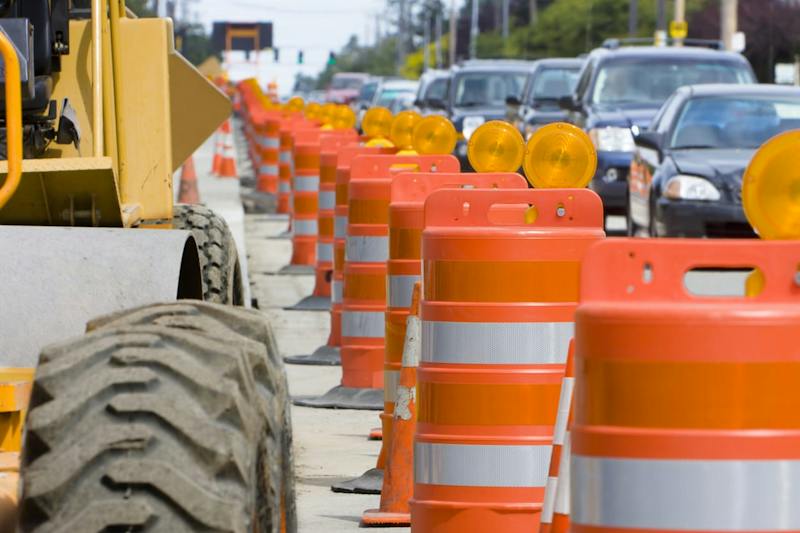
Construction zone accidents are among the most legally complex car accident cases. When the road itself contributes to a crash, responsibility can fall on a government agency, a private contractor, a subcontractor, or another driver, and sometimes all of them at once.
Construction Zone Accident Claims: Big Auto Investigates Every Responsible Party
At Big Auto, our car accident team treats construction zone crashes differently from other cases because the liability picture is fundamentally different. The driver who hit you may not be the primary source of your recovery.
The agency that approved the traffic plan, the contractor that set up the lane closures, or the subcontractor that left a hazard in the road may bear equal or greater responsibility.
Identifying all liable parties in a construction zone case requires fast action, specific legal knowledge, and an understanding of the federal and state standards that govern how these zones must be designed and managed.
Why Construction Zone Accidents Are Legally Complex
Most car accident cases involve two parties: a driver at fault and an injured victim. Construction zone accidents frequently involve four, five, or more: the general contractor, subcontractors, the government entity that issued the permit and approved the traffic control plan, equipment manufacturers, and other drivers whose behavior was shaped by inadequate signage or sudden lane changes.
Each party may be covered by a different insurance policy. Each may have different notice requirements before a lawsuit can be filed. And each may point fingers at the others to minimize their own exposure. Getting the right result requires naming the right parties and building the right evidence from the start.
Who Might Be Responsible for a Construction Zone Crash
Before any strategy can be developed, the responsible parties must be identified. In a construction zone accident, that investigation typically examines:
- The general contractor: Responsible for overall site safety, traffic control plan implementation, and compliance with the terms of their contract with the government
- Subcontractors: May bear separate responsibility for specific hazards they created, such as unmarked lane drops, debris in the roadway, or improperly placed barriers
- The government entity: The state, county, or municipal agency that designed the project, approved the traffic control plan, and has an ongoing duty to maintain safe conditions
- Equipment or materials manufacturers: If a barrier, sign, or road surface failed in a way that contributed to the crash
- Other drivers: Drivers who speed through construction zones, ignore posted warnings, or fail to merge safely are independently liable for the accidents they cause
Government Liability: Sovereign Immunity and Its Exceptions
Government entities occupy a special legal position in personal injury cases. Under the doctrine of sovereign immunity, governments historically could not be sued without their consent. Every state has now waived sovereign immunity to some degree through government tort claims acts, allowing injury victims to sue government agencies under specific conditions.
Those conditions vary significantly by state. Generally, to sue a government entity for a construction zone accident, you must show:
- The government had a duty to maintain safe road conditions in the construction zone
- The government knew or should have known about the hazard through notice, actual or constructive
- The government's failure to act caused or contributed to the crash
- Your damages fall within the categories compensable under the relevant tort claims act
Government liability in construction zone cases can arise from defective road design, failure to approve an adequate traffic control plan, inadequate inspection of contractor work, or failure to respond to known hazards in the zone.
The Notice of Claim Deadline You Cannot Miss
This is often the most time-sensitive issue in a construction zone case involving a government entity, and it is where many otherwise strong claims are permanently lost.
In Arizona, A.R.S. § 12-821.01 requires that anyone with a claim against a public entity file a formal Notice of Claim within 180 days after the cause of action accrues. A claim not filed within that window is barred entirely, regardless of how serious the injuries or how clear the liability.
The Notice of Claim is not a formality. Under Arizona law, it must contain:
- Facts sufficient to permit the government entity to understand the basis for the claim
- A specific dollar amount for which the claim can be settled
- The facts supporting that dollar amount
A general description of the accident is not enough. If the notice is missing the required settlement amount or lacks adequate factual support, it can be rejected as defective, which is as fatal to the claim as missing the deadline altogether.
A.R.S. § 12-821 sets an additional limit: any lawsuit against a public entity or public employee in Arizona must be filed within one year of the cause of action accruing. That is shorter than Arizona's standard two-year personal injury limitation for private defendants, and it underscores why early action is not optional in these cases.
Every state has its own government tort claims act with its own notice deadlines and content requirements. Some allow as few as 60 days. Big Auto's attorneys operate nationwide with local co-counsel who know the exact rules in every jurisdiction and ensure that no deadline passes unmet.
Contractor and Subcontractor Liability
Private contractors and subcontractors do not enjoy sovereign immunity protections. They are held to the same negligence standards as any other private party, and in construction zone cases, those standards are specific and federally defined.
Contractors are responsible for designing and implementing a traffic control plan that protects both workers and motorists. They must install appropriate signage, barriers, lane markings, and lighting. They must respond to changing conditions, repair hazards promptly, and ensure that their subcontractors follow the same requirements.
Common contractor failures that lead to accidents include:
- Missing or inadequate advance warning signs
- Abrupt lane drops without proper merge tapers
- Debris, uneven pavement, or unmarked drop-offs in the travel path
- Barriers placed too close to live traffic lanes
- Inadequate lighting in nighttime construction zones
- Flaggers or pilot car operations that create confusion rather than clarity
The Federal Standard That Defines the Duty of Care
The standard against which all construction zone traffic control is measured is the Manual on Uniform Traffic Control Devices (MUTCD), published by the Federal Highway Administration. Part 6 of the MUTCD establishes specific requirements for temporary traffic control in work zones, covering everything from sign placement distances to barrier specifications to flagger procedures.
When a contractor or government agency fails to comply with MUTCD standards, that failure is not merely a safety concern. It is evidence of negligence. In many jurisdictions, a MUTCD violation that contributes to an accident can establish negligence per se, meaning the jury does not need to separately evaluate whether the standard of care was breached.
The FHWA also requires that every federal-aid highway project have a formal Transportation Management Plan that addresses work zone safety and traffic flow. When that plan is missing, inadequate, or not followed, it opens additional grounds for liability.
Other Drivers as a Source of Liability in Construction Zones
Not every construction zone accident is caused by the road condition. Other drivers remain independently responsible for their conduct, even in a zone where conditions are confusing or dangerous.
A driver who speeds through a posted reduced-speed zone, tailgates, fails to merge when warned, or rear-ends a vehicle that has slowed for construction is liable for those choices regardless of what the contractor did or did not do. In some cases, both a negligent driver and a negligent contractor share liability, and both can be pursued.
Comparative Fault in Arizona
Under A.R.S. § 12-2505, Arizona follows pure comparative fault: an injured victim can recover damages even when they share some responsibility for the crash, with compensation reduced only in proportion to their own degree of fault.
A.R.S. § 12-2506 adds another layer that makes naming every responsible party especially important. Arizona abolished joint and several liability, meaning each defendant pays only their assigned percentage of fault. If a negligent contractor or government agency is never named, their share of the damages may be permanently beyond reach.
Why Construction Zone Claims Require a Different Legal Strategy
The combination of government defendants with strict notice requirements, private contractors with overlapping responsibilities, and federal traffic control standards that define the duty of care makes construction zone cases unlike any other car accident claim.
Our car accident attorneys at Big Auto handle cases nationwide with local co-counsel who know the specific government tort claims act requirements and notice deadlines in every state. We investigate the full scope of liability from day one, because in construction zone cases, the clock starts running the moment the crash happens.
If you were injured in a construction zone accident, do not assume the driver who hit you is the only party responsible. Contact Big Auto today for a free case review and let us find every source of liability before any deadline passes.