
Can A Pedestrian Be Liable In A Car Accident?
FREE CASE REVIEW FREE CASE REVIEW ⟶Table of Contents:
- Pedestrians Do Not Always Have the Right of Way
- How a Pedestrian Can Be Found Liable
- What Happens if Both Parties Share Fault?
- Evidence Used to Determine Pedestrian Liability
- What If the Pedestrian Is Injured?
- Can a Driver Recover Damages From a Pedestrian?
- Why Pedestrian Cases Are Often Disputed
- How Big Auto Approaches Pedestrian Liability Cases
- Understanding Your Rights Matters
- Speak With Big Auto About Your Pedestrian Accident Case
When a pedestrian is struck by a vehicle, many people assume the driver is automatically at fault. While drivers do have a heightened duty to watch for pedestrians, pedestrians also have legal responsibilities. Under Arizona law, a pedestrian can be partially, or even primarily, liable for a car accident depending on how the incident occurred.
Understanding pedestrian liability is important for both drivers and pedestrians, especially when injuries are serious and insurance companies begin assigning fault.
Pedestrians Do Not Always Have the Right of Way
Arizona traffic laws clearly define when pedestrians have the right of way and when they do not. Pedestrians are generally protected when they:
- Use marked crosswalks
- Follow traffic control signals
- Cross at intersections where pedestrian signals permit crossing
However, pedestrians may lose that protection when they:
- Cross against a traffic signal
- Enter the roadway suddenly
- Walk into traffic outside a crosswalk where yielding is required
Drivers must still exercise reasonable care, but the law does not excuse unsafe pedestrian behavior.
How a Pedestrian Can Be Found Liable
A pedestrian may be found liable if their actions contributed to the crash. Common examples include:
- Jaywalking in violation of traffic laws
- Darting into traffic without sufficient time for a driver to react
- Walking along a roadway where sidewalks are available
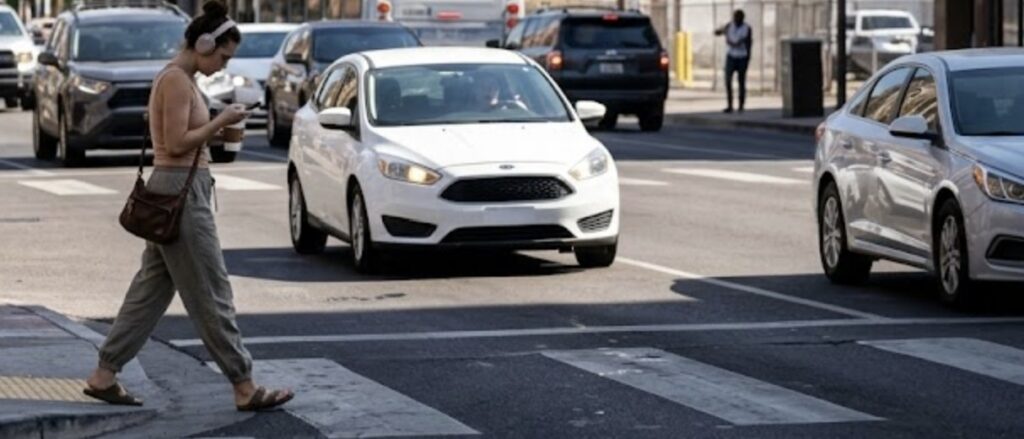
- Being distracted by a phone or headphones
- Crossing outside designated pedestrian zones
Arizona applies a pure comparative negligence system. This means liability can be shared between the driver and the pedestrian, and compensation is adjusted based on each party’s percentage of fault.
What Happens if Both Parties Share Fault?
Shared fault is common in pedestrian accidents. For example, a driver may be speeding while a pedestrian crosses against a signal. In that situation, fault may be split between both parties.
Consider an imaginary scenario for illustration:
A pedestrian crosses mid-block at night while wearing dark clothing. A driver is traveling slightly above the speed limit and does not see the pedestrian until it is too late. A jury may find both contributed to the accident, assigning percentages of fault to each.
Even if a pedestrian is partially at fault, they may still recover compensation, though the total amount may be reduced.
Evidence Used to Determine Pedestrian Liability
Determining liability requires careful analysis. Evidence often includes:
- Police reports and diagrams
- Traffic camera or surveillance footage
- Witness statements
- Vehicle damage patterns
- Visibility and lighting conditions
Insurance companies examine this evidence closely to minimize payouts. Early legal involvement helps ensure evidence is preserved and accurately interpreted.
What If the Pedestrian Is Injured?
If a pedestrian is injured, their own conduct will still be evaluated. Medical expenses, lost income, and pain and suffering may be recoverable depending on fault allocation.
Pedestrians may also have coverage through:
- The driver’s auto insurance
- Their own uninsured or underinsured motorist coverage
- Health insurance
Sorting through these options requires careful legal analysis.
Can a Driver Recover Damages From a Pedestrian?
Yes, in certain situations. If a pedestrian’s negligence caused property damage or injuries, a driver may pursue a claim against the pedestrian. This often involves the pedestrian’s homeowners or renters insurance policy, if applicable.
These cases are less common but legally possible.
Why Pedestrian Cases Are Often Disputed
Pedestrian accidents frequently involve severe injuries, which increases financial exposure. Insurance companies may aggressively dispute liability to reduce payouts.
Statements made at the scene, assumptions about right of way, and incomplete evidence can all influence outcomes. That is why legal guidance matters early.
How Big Auto Approaches Pedestrian Liability Cases
At Big Auto Accident Attorneys, our focus is on accurately determining fault, not assumptions. We:
- Analyze traffic laws applicable to the specific location
- Review evidence objectively
- Counter improper fault-shifting by insurers
- Protect clients from being unfairly blamed
When accidents occur outside Arizona, we coordinate with co-counsel through the Big Auto Accident Attorneys Team to ensure compliance with local laws.
Understanding Your Rights Matters
Whether you are a pedestrian or a driver, liability is not automatic. Arizona law looks at actions, timing, and reasonableness under the circumstances.
Waiting too long to get legal advice can allow narratives to form that are difficult to reverse.
Speak With Big Auto About Your Pedestrian Accident Case
If you were involved in a pedestrian-related car accident, understanding liability is essential. Big Auto Accident Attorneys serves clients throughout Arizona and provides clear guidance on fault, compensation, and next steps.
Call (844) 244-2886 or visit our Phoenix office at 3550 N Central Ave, Suite 550, Phoenix, AZ 85012 to discuss your case. The sooner liability is evaluated, the stronger your position becomes.

Content reviewed by managing attorney, Nic Edgson. Nic has been an Arizona-licensed lawyer for more than a decade and focuses his law practice on helping people seriously injured in car accidents and truck accidents. He has represented thousands of clients and recovered more than $50 Million Dollars fighting for their injuries and medical bills. Throughout his legal career, Nic has helped those injured through some of the most difficult times in their lives.
You Need Big Auto.

Your message has been sent
Thank you for your message, we will get back to you soon.
By clicking “submit” a visitor understands and agrees that sending information to the firm will not create an attorney/client relationship and may not be kept confidential. Information sent through this link will be used to check for conflicts and schedule a consultation. An attorney-client relationship is formed only when both a potential client and a lawyer with the firm both sign a fee agreement. By submitting your contact information, you agree that we may contact you by telephone (including text) and email in accordance with our Terms and Privacy Policy.